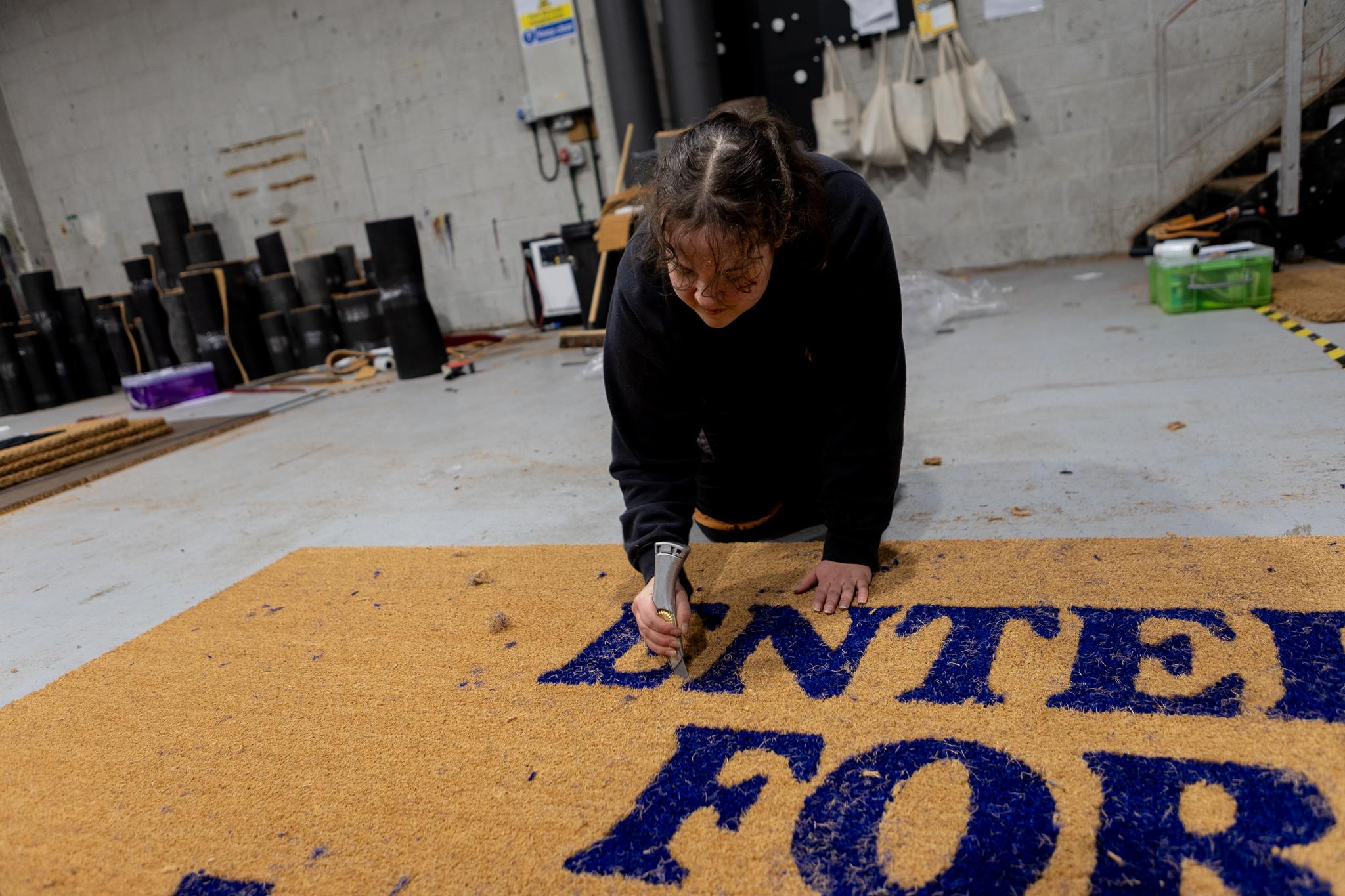
Make An Entrance is a Lincoln-based manufacturer specialising in made-to-measure entrance matting, personalised coir mats and bespoke logo mats. We have been based in Lincoln for more than 20 years and manufacture much of our product range in our own local workshop.
We are proud to be a small Lincoln business that combines traditional manufacturing skills with modern technology and, increasingly, a strong social purpose. Alongside growing the commercial business, we have been developing opportunities for people who may face barriers to employment, including work linked to rehabilitation, skills development and helping people take their first steps back into the workplace.
We have also established the Make An Entrance Foundation to build on this work and ensure that social impact becomes an integral part of how the business develops rather than simply an occasional charitable activity.
Why did you choose to sign up to the charter?
The principles behind the Charter reflect a great deal of what we already believe a responsible local business should be doing.
For us, being a successful business should not just be measured by turnover or profit. It should also be about the jobs we create, the people we support, the businesses we buy from locally and the contribution we make to Lincoln and the wider community.
Signing the Charter gave us an opportunity to make a visible commitment to those principles, but it has also encouraged us to think more systematically about social responsibility and how we can build it into our everyday decision-making.
As an SME, we also want to demonstrate that meaningful social impact is not something that is only achievable by very large organisations. Small businesses collectively have an enormous part to play.
Have you noticed any positive changes since undertaking a range of socially responsible activities?
Absolutely. Perhaps the biggest change has been in the way we think about our role as a business.
Our work with employment, skills and rehabilitation has introduced us to people and organisations we might never previously have encountered and has opened up new partnerships across Lincolnshire.
It has also had a positive effect internally. Our team can see that the work they do contributes to something wider than simply producing and selling a product. We are increasingly looking at recruitment, training, purchasing and investment decisions through a social-impact lens.
We have also found that social responsibility can lead to commercial opportunities rather than competing with them. Customers, public-sector organisations and other businesses increasingly want to understand the values and impact of the companies they work with.
Most importantly, we have seen how even relatively small interventions from an employer can make a significant difference to somebody who needs an opportunity, confidence or simply a way back into work.
Do you have any words for a business looking to sign up to the charter?
I would say: don’t wait until you think you are doing enough. Sign up and start somewhere.
Social responsibility does not have to mean launching a huge programme or spending large amounts of money. It could be giving somebody their first work experience opportunity, buying from another local business, supporting a community organisation, reducing waste, offering a little flexibility to somebody who needs it, or giving an employee the opportunity to develop.
Once you start looking at the business through that lens, you begin to see opportunities everywhere.
For SMEs in particular, we often have an advantage because we can make decisions quickly and do things on a very human scale. If enough Lincoln businesses each do something relatively small, collectively the impact on the city could be enormous.